
My mind, like the shadowless town in Murakami’s novel, has uncertain walls.
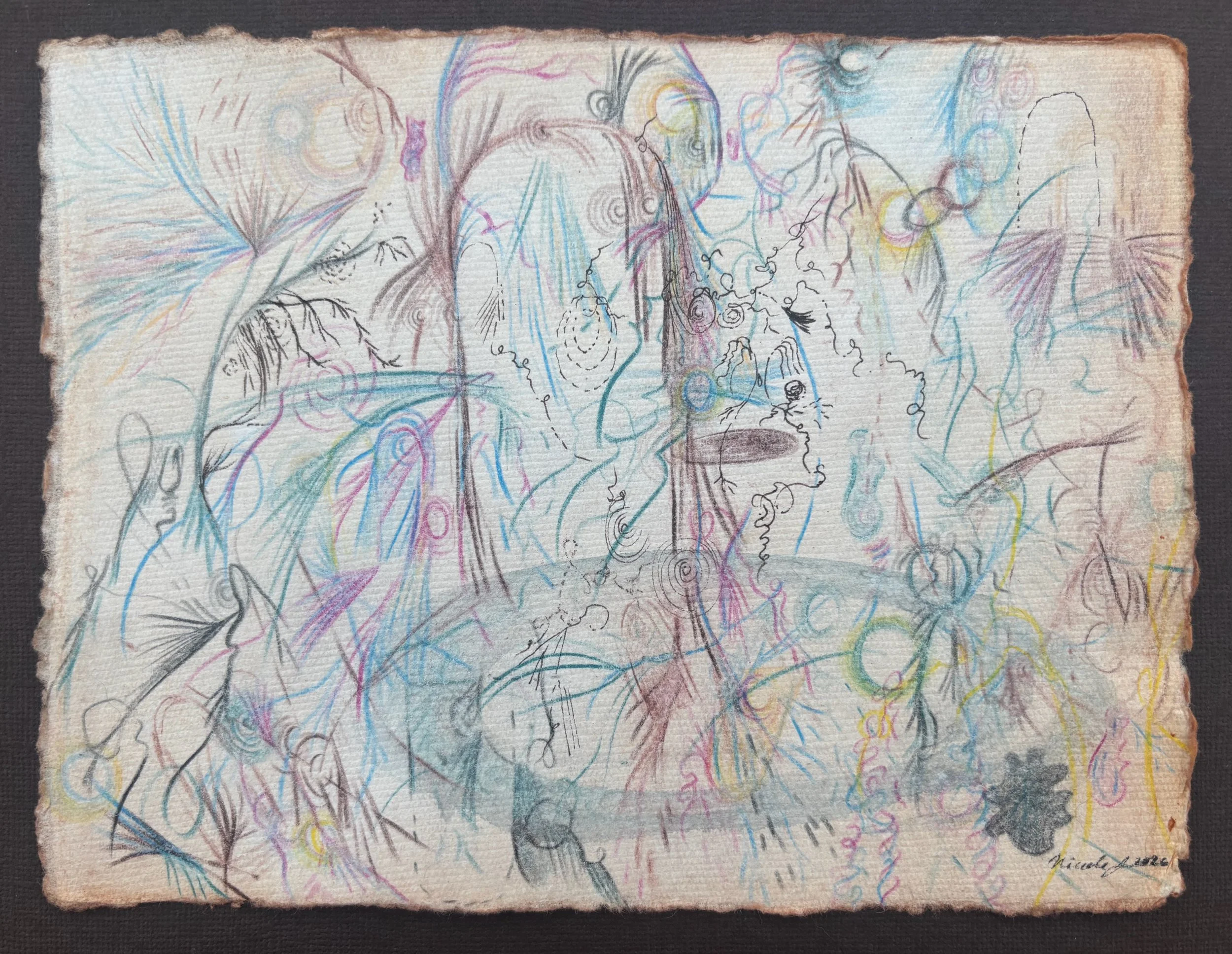
“a palladian door, some portals, yes, willow tree, of course, go on, walk through, you've already arrived and you are always arriving, aren't you?”
Watercolor, colored pencil, and ink on paper. 6 x 8 inches. 2026.
Dearest Doodle Soupsters,
What do you see in the artwork above?
I see trees overlapping with portals, sprouting doorways, archways, pathways …
Why trees?
Swirling trees with wispy lines transforming into faces, portals, glowing circles, orbs, maybe the sun, maybe the moon, maybe centers of energy, emotion, sound vibrating, my voice taking both the pain and awe of being alive, constantly trying to make sense of what doesn’t …
This is a core motif for me. Why?
Years before writing the Whispers Among the Trees story and starting this series, I drew a girl breathing life into trees.
Of course, trees provide oxygen, which allows us to breathe in the first place. But looking back, I think I really meant that this girl anthropomorphized trees — that the trees gave her life and in return, she made stories that helped them come alive in new ways. I never finished that project, and I understand why.
In the Afterword to his novel The City and Its Uncertain Walls, Haruki Murakami references a quote from another writer, “As Jorge Luis Borges put it, there are basically a limited number of stories one writer can seriously relate in his lifetime. All we do—I think it’s fair to say—is take that limited palette of motifs, change the approach and methods as we go, and rewrite them in all sorts of ways.”
He goes on to say, “Truth is not found in fixed stillness, but in ceaseless change and movement. Isn’t this the quintessential core of what stories are all about?”
Back in March, I had just finished reading the novel and I reflected on how Murakami’s afterword helped me make sense of my own process in the CDS edition, “In My Bones.”
I wrote then:
Ocean waves caressing the shore, rolling in and out, can feel so serene. Yet, they’re constantly moving.
Truth is found in rolling in and out. Something real unearthed through repetition that’s never neatly the same. No wave has precisely the same shape or rhythm as another.
And this is one of the lessons of nature, right?
There’s something true and almost constant embedded in change, something that’s found over and over again a little differently, maybe a bit deeper too each time. A form that’s perpetually taking shape and already is at the same time.
I think this is simply how things are meant to be, not that I always think “meant to be” is a thing. I mean, how could all the tragedy and horror in the world be meant to be? That doesn’t make sense. In other words, it feels wrong to think of trauma and loss as “meant to be.”
So I rephrase … maybe meaning is something found but it’s also something we give. That doesn’t make abuse or pain or war or cruelty or suffering right. It doesn’t.
And sometimes, it’s time for meaning-making and sometimes, it is time to simply get through. I kind of hate this fact because I often want the world to be more kind, beautiful, and sweet than it is. And I can just let myself be angry and hate things too. It’s just a feeling. Just a thought. I don’t have to get rid of this. It can be there. That’s alright.
When I try to force meaning-making, it’s often to skip over that part. The sadness. The anger. The confusion. Grief. And I circle on back to another truth: grief can’t be skipped over.
Now, I’m thinking of those sketchbooks from a decade and more ago, drawing faces with roots for hair, trees growing from the crown of the head. And now, I’m thinking of that nightmare I had as a young child — my teacher and the other students shaved their heads, then leaves sprouted from their smooth, bald surfaces. Growing, growing, fast, too fast.
I didn’t understand the nightmare then. It was so vivid though. I’ve had many vivid dreams, but this one was one of the most intense. It has stuck with me for about 20 years. I think I understand it now. Everyone was growing up. We’d be moving on to middle school in a year or two. Puberty was happening all around me. And yet, I was frozen.
Of course, I wasn’t, not completely. But being mostly frozen is kind of worse. Aware, even a sliver, of the places where I was unconscious, knocked out, petrified.
It’s interesting, isn’t it? That petrified can be terrified, or turned to stone. I mean it in both ways. I couldn’t let myself go through puberty. What would I feel then? What would I realize?
So I froze. So I turned myself to stone, as best I could.
I’m in the middle of writing a story about a boy who ventures out after a snowstorm and stumbles upon a frozen girl. He reaches for her hand and when they touch, there’s a sound. A crackle. She thaws. Light springs to her eyes. And then, they amble through the woods together to find fire.
The first parts of the story just flowed. I didn’t have to think. But recently, when I try to write the rest, there’s something I keep bumping into … the story isn’t quite incubating — it’s more like I keep stumbling into some dark corner of my brain and I’m unsure if I want to turn on the lights, see what’s there. Is that true? I already know what’s there, don’t I? I’ve already arrived, and yet, I’m always arriving, still? Is that it?
What is the difference between the 10-year old me or 20-year old me and who I am today? Am I just as lost? Just as scared to face myself and by myself, I really mean what I’ve experienced, the memories of what was done to me and not because of me?
How do I tell the difference between needing to go at my own pace, to not rush, and hesitation, avoidance?
I’m learning how. And, time is weird. What feels like a long time, “too much hesitation,” could be days, weeks, a month or so? Not the same as the years I spent as a child and teenager running away from myself because it didn’t feel safe to acknowledge the truth, even within the walls of my own mind.
In Murakami’s novel, The City and Its Uncertain Walls, the main character is transported to a shadowless, walled town. He tries to make a map, to draw the shape of the walls, but the walls move.
In Whispers Among the Trees, I anthropomorphize the concept of existence and “put Her” in the form of a woodland fairy. As the strange human character speaks with Existence, this anthropomorphized concept shifts, fractures, resolidifies, quivers once again. The walls keep moving, changing shape.
In The Edge of Space-Time, physicist Chanda Prescod-Weinstein writes:
You have a formula that tells you how things change with time, space, or both. Given a couple of bits of information about how those things behave initially or at some physical boundary, you can come up with a solution to the formula that allows you to describe what is happening, what has happened, and what will happen. It’s that simple, in principle, at least in the deterministic world of Newtonian physics, though the equation can sometimes be difficult or impossible to solve.
Boundares are evidently valuable. But sometimes we strain against them. We want to know what’s inside a black hole and whether the universe can have an edge—if it has an edge, how do we think about what’s beyond that boundary? If the universe is unbounded, does that mean there is nothing beyond it? We need boundaries, but we also struggle with what they may be telling us.
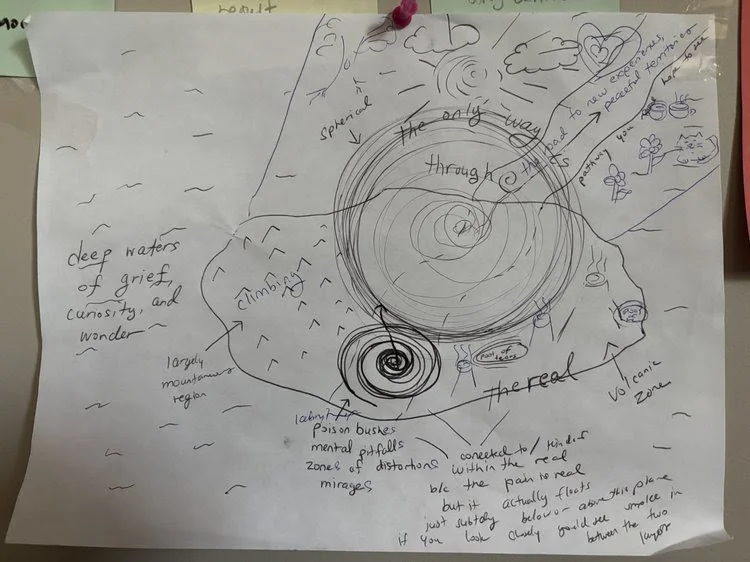
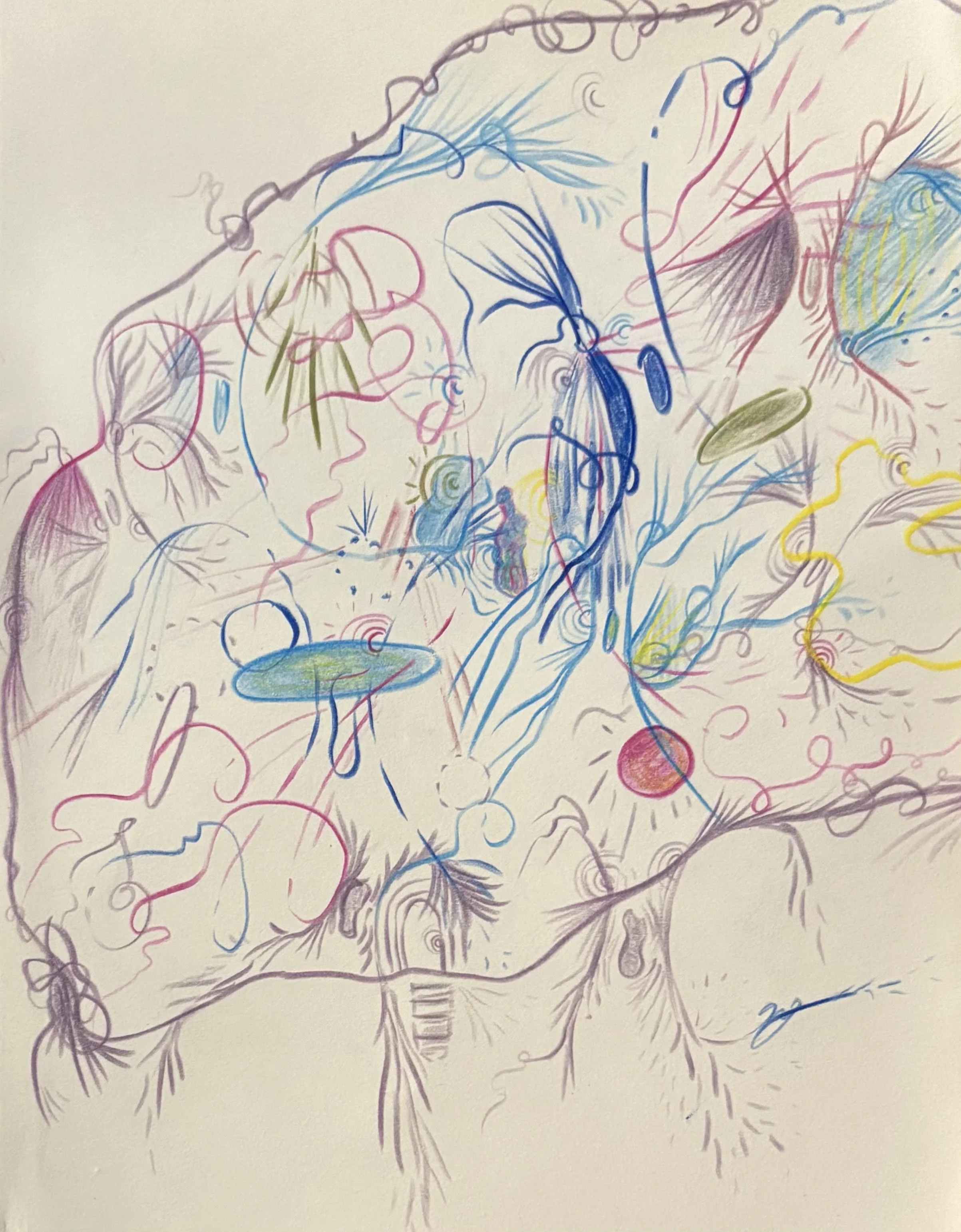
A few months ago, I tried drawing a map of my internal landscape (above). Yet, in charting my mind, the more aware I became of oversimplifications. At the same time, this map has been useful. It allows me to hold an overarching view of what’s going on inside my brain that could help me navigate.
I mean, imagine if you were trying to use Google Maps to go somewhere and instead of just telling you turn right here, with the path highlighted, it pointed out every bump in the road, every rock, every sign, every storefront, every gradation in color, in sound that you passed by.
And while maps are pretty hard to use if there’s too exhaustive, in leaving anything out, there are holes, inaccuracies, missing nuances, etc. These holes (and details) are real, even if you can still get from point A to point B without noticing them.
My mind, like the shadowless town in Murakami’s novel, has uncertain walls. As soon as I notice a boundary, I may immediately look beyond it. In other words, in becoming aware of the boundary, the boundary may disappear or lose its power.
Or, I map it out and the patterns remain — the walls might even shift to prevent me from going past the boundary. As I approach a poison bush to simply inspect it, I become close enough to fall under its spell. I cannot see the whole picture from up close. Without a map, I cannot hold the bird’s eye view in my mind ….
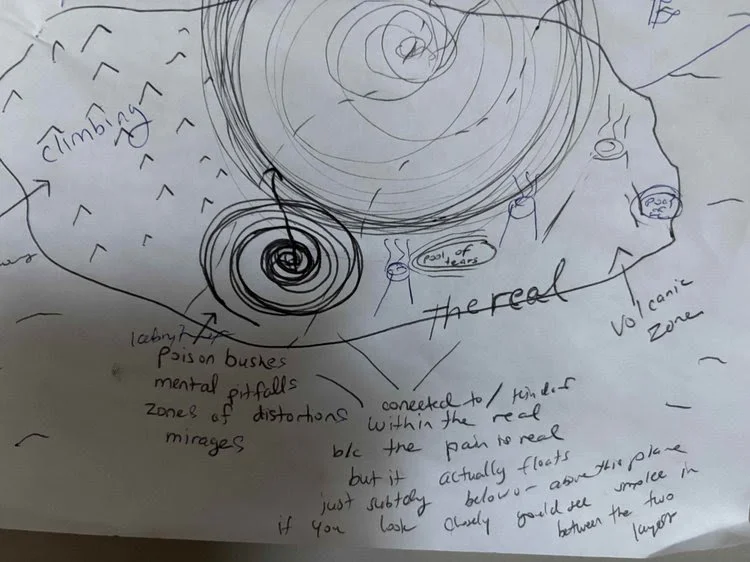
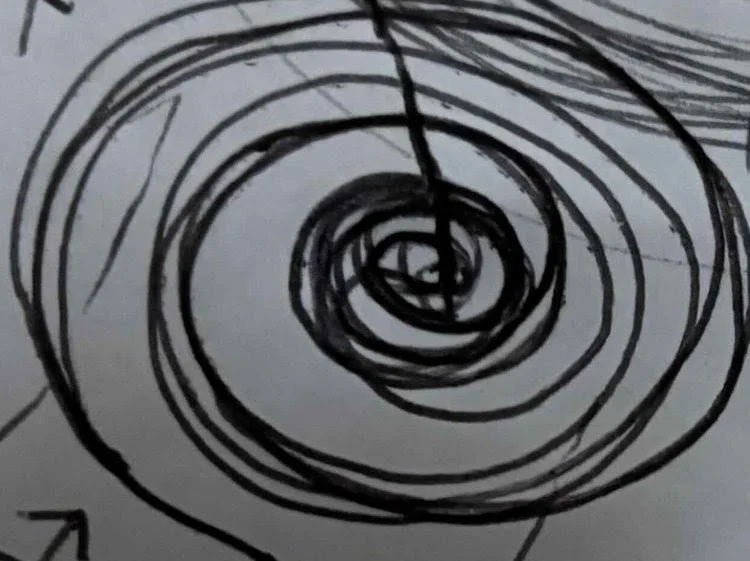
So I think, for a while, this panic must be real. There must be something happening now. Something bad. Something I must figure out … Now, I am running again. Running in circles. Yet, in running in circles, in observing myself running in circles, I am still learning. I am making sense of my habits. Of what’s a memory that lives in my body, what’s real yet has passed. I am here now. I learn over and over again, how much terror still lives in me. The extent to which I am still in the process of thawing my frozen parts. And that I didn’t “petrify” because I was “too” afraid. I was afraid, for good reason. Fear isn’t bad. Fear has function. It is information. Fear helped me survive. Fear told me (a child with a bold, curious, courageous nature) when to be quiet, when to shut down, when to preserve my most wonderful, vulnerable parts because it wasn’t safe to let myself thrive, because there was no “thriving,” only getting through to the next day so that maybe someday I could … and someday has arrived now, and it’s still arriving …
In other words, constantly create exhaustive, detailed, granular maps, ask every question, investigate every doubt — well, that won’t aid navigation, will it? And the walls can still move, reformulate.
It’s more about understanding my walls than knowing exactly where they are at all times. That’s how I transcend them, and also let them be what they are. It’s knowing that this line or that, the placement may be arbitrary and the impact is real.
This idea of edges has been coming up in my art a lot lately … the shape sometimes looks like the knot of a tree, the edge of a cliff, lines on a map fraying, blurring …
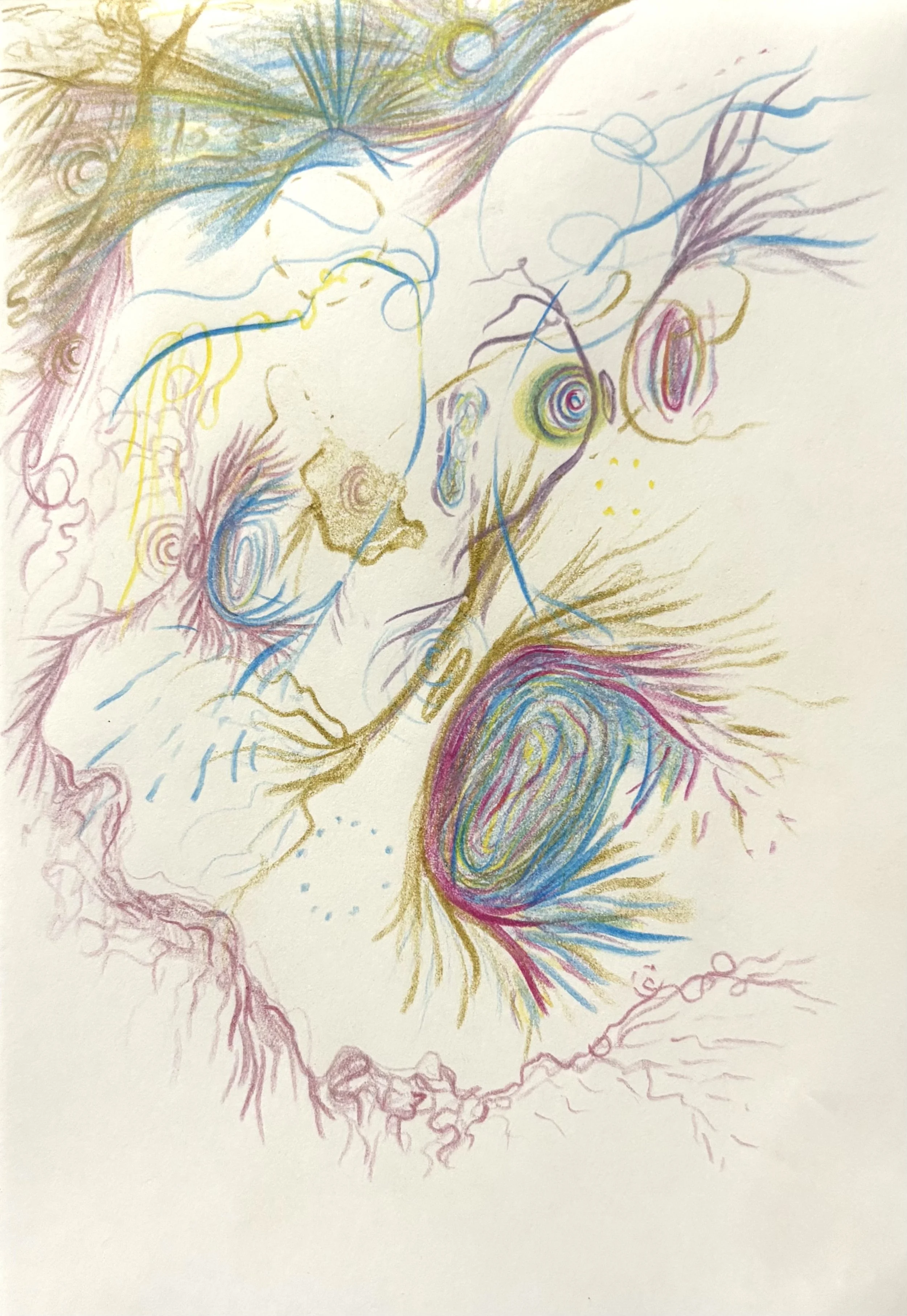
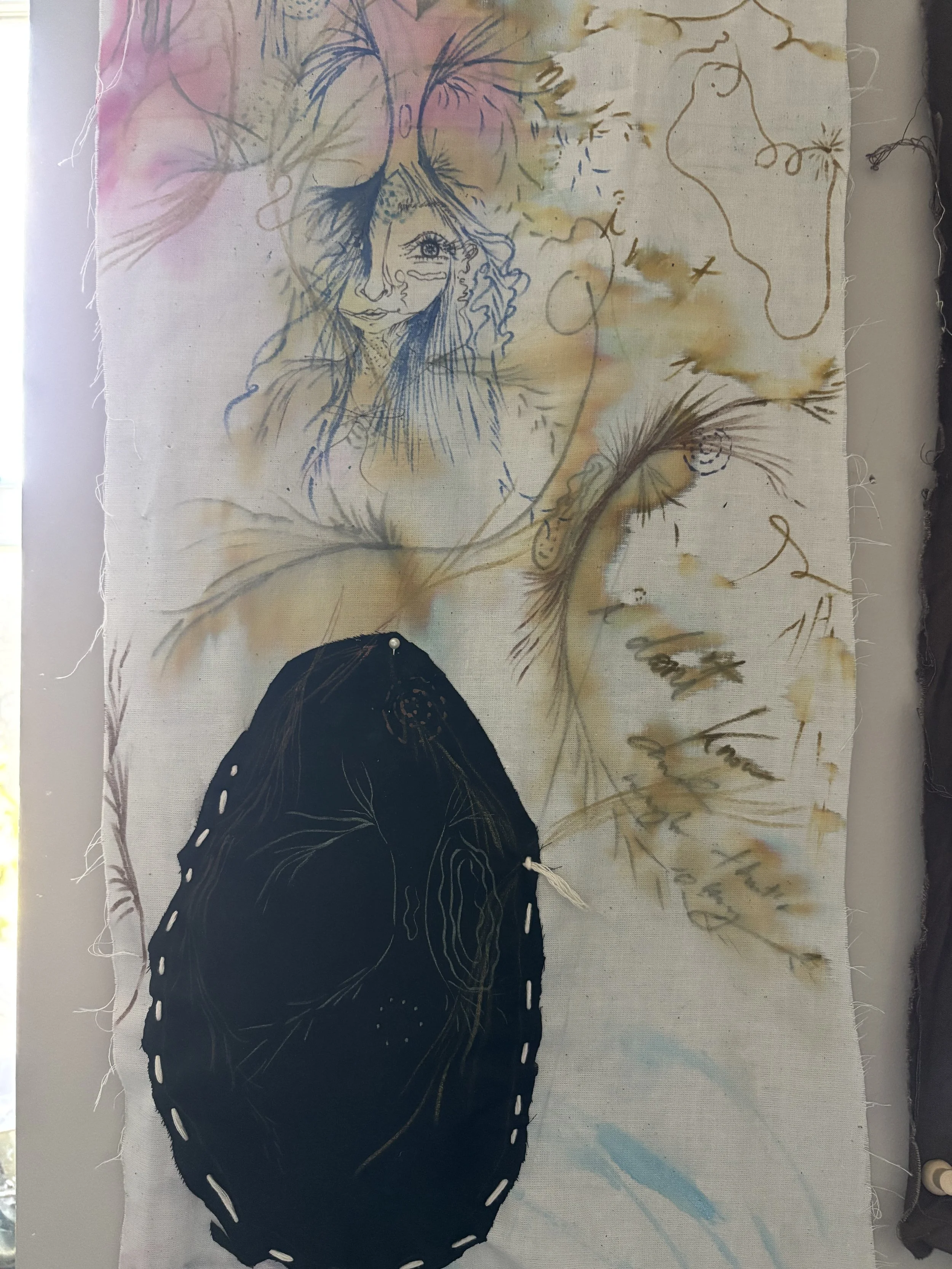
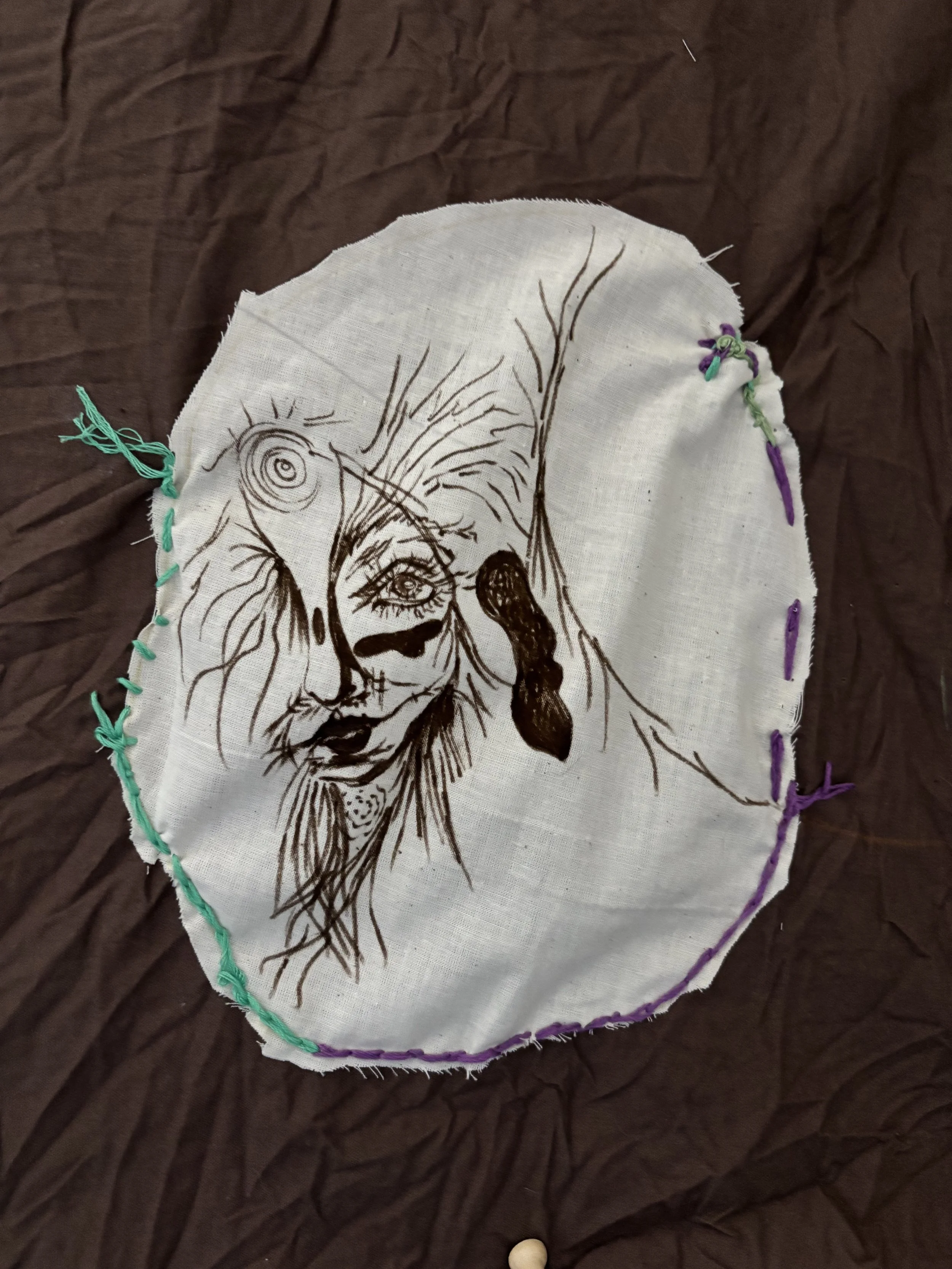
Sometimes, there’s an opening, or overlapping lines, criss-crossing, leaving the possibility available that the threads can be untangled, a rickety fence can be pulled apart … openings can emerge, new pathways can be found.
I’ll end this edition of Chicken Doodle Soup with a section of Whispers Among the Trees that I haven’t shared yet, “Part XII: The world is more like a kaleidoscope than a T chart” … the human’s words are in italics, and Existence’s words are bolded.
Why am I here? Where am I going?
To live. As for the second, you decide.
What is destiny, then?
A path you choose to follow.
What is choice?
A mystery. Nonetheless, it is real.
What is time? A series of moments? A loop? Marching along a number line?
Time is felt, experienced.
So it is just a feeling? It’s not real?
No. Time is felt because it is real. It is interwoven with the deepest and darkest of the Real. Time allows for death. Time allows for loss. Time allows for grief.
Time is bad?
No.
Time is good?
What is good?
I asked you that.
What is it with this human impulse to split the world in two? The world is more like a kaleidoscope than a T chart. The Real cannot be divided into good and bad, right and wrong, yes and no, pro and con, this and that or that and this or the other.
I think we just want to understand. We are just trying to make sense of being alive. Plus, you said I am good. Are you saying that there is no good?
Of course, there is good. However, Time cannot be good or bad. Good is Good. Bad is Bad. Time is Time. Human is human. Spiritual is spiritual. Rain is rain. Night is night. Day is day. Day is not bad. Night is not bad. Sun is not better than Moon. Moon is not better than Sun. Trying to fit all there is into binary categories simply doesn’t work. There is right and wrong. There is good and bad. Not everything can be labeled based on good and bad. Some things sit in-between. There is black and white, sure. The existence of gray doesn’t erase the existence of black and white, or any other color for that matter, and vice versa.
Okay. But aren’t all humans in-between, then?
Maybe, to a certain extent, everything is somehow in-between because you can simply enhance the details to see further gradation. Yet, that is also a paradox, isn’t it? The infinite in-between co-exists with the finite. Human lives are finite. Yet, view a human life in the context of the spiritual and maybe, that truth begins to feel more complicated. It is complicated, sure. And can be viewed through the lens of many different perspectives. And still, a person dies. And that specific person’s existence is over. Their life is finite. A person’s days are numbered even if the soul survives infinity. The purpose of being human is to be real, to be specific, to be strange in your own weird little ways, even if it’s just for a small while in the context of the universe’s grandeur.
My existence is small and big, at once. In the history of all there is, I am a tiny blip. And still, each person’s life causes ripples that are a part of forever. And still, right now, I mean the world to someone. And that someone is my whole world. I hold him, and that split second is the sweetest little slice of heaven any Existence fairy could hope to taste. Every split second matters so much and so little, at the same time. And who cares about any of that or this when another human holds you in their arms and promises to never let you go, to be your world for as long as you’ll let them? Nothing else matters except to love and be loved. That’s how it feels. And it is the truth and even if it is just one of many truths, to be held like that is to know that often enough, it is the only truth that fully matters. And my words are chock full of paradoxes because the paradox is the truth. Existence is built on paradox. Sometimes, I hate you for it. I don’t know how to accept that destruction and creation are two sides of the same coin. And other times, I love you for it. Because this paradox is what makes life magical.
Trying my best to see through the kaleidoscope and accept what’s here, and to navigate among all these special (and confounding, and heart-breaking) details,
Nicole Sylvia Javorsky